Friday, April 2, 2010

Bukharan Bazaar: The End

Our last (for the time being) adventure in Bukharan cuisine takes us to Taam Tov on West 47th Street in Manhattan. As I make my way toward Sixth Avenue, deep in the heart of the diamond district, people thrust flyers in my hand, offering to buy every ounce of precious metal on my body, and with gold at $1,140 an ounce and the economy still sinking, this may not be such a bad idea.


The restaurant’s on the third floor at 41 West 47th, and the easiest way to find it, at least on weekdays, may be to look for the guy in traditional Uzbek dress—a deep-blue tunic richly embroidered in gold—wearing a sandwich board advertising the house specialties: shish kebab, shavarma, “bbq steak,” and pilaf. At lunchtime, this is a bustling place, packed with construction workers, jewelers and gem dealers, and other neighborhood regulars, with nary a Yuppie in sight.


The menu runs a by-now-familiar gamut of hummus and “borsch” to lagman soup and kebabs of lamb, beef, veal’s liver, or fish. Many of these are helpfully if primitively pictured on the menu, the different dishes arrayed around a central image of what looks to be either a peculiar delicacy from Carvel, with two scoops of ice cream on top, or a mummified umbrella stand. But no, Dave informs me, this thing called shvarma or shavarma is a sandwich-like wrap of shaved meat wrapped around a vertical spit and grilled for as long as a day, tenderized and kept juicy by chunks of fat tucked within.


Well, fine, but not for lunch, I think, watching big platters heaped with golden fries glide by. I’m drawn to a picture of stroganoff on the menu, stirred by memories of one of my suburban mother’s favorite 1960s party dishes. So we order that and stuffed cabbage and another plate full of pilaf and a couple of diet Cokes to wash it all down and keep the calorie count lower than the price of gold (though, we learn later, beer and wine are also available).


The stroganoff proves disappointing: tender strips of beef in a tomato-based sauce (my mother always added sour cream to hers). It’s sadly short on oomph. Dave claims the Afghan versions he’s sampled in Kabul are considerably more robust and spicier. The stuffed cabbage, though, is hearty and satisfying, and the pilaf, laced with meat I can’t identify but the waitress says is chicken, is a tantalizing mélange of grains spiked with cumin, cardamom, and cloves.


The three generous entrées run up a tab of about $10 each, and with gusto but some embarrassment we polish off almost everything put in front of us, including the “cake of the day,” a kind of doughy croissant wrapped around a chopped walnut filling ($3 for two).

With its blue-plastic tablecloths, Taam Tov bears more of a resemblance to a roadside eatery on some back-roads blue highway rather than a midtown lunch joint. But one of its more curious features is a terrace overlooking a construction site, and because it’s a bright sunny day, several people move outdoors.


“Hey, Dave,” I say, “imagine this scenario: You’ve just bought your fiancée a knockout engagement ring in one of the stores around here and you bring her to Taam Tov for a romantic feast on the balcony. How do you think that would play out?”


Dave gives me a look. And then changes the subject by popping a sprig of parsley in his mouth. “At least you know you can eat the greens here.”


“What do you mean?”


“In Afghanistan, they use night soil as fertilizer. You don’t want to have much to do with vegetables. Sometimes they wash carrots in the ditches, because that’s the only water available. They dump them from bags on the donkey and then jump up and down on them to wash off the dirt.”

I give Dave a look.


“We once saw a skit in which the lead character runs around wailing, ‘Abdul, why do my carrots taste of feet?’”


Yeah, well. That’s in Afghanistan. The food here is hearty, if not inspired, and if you consider that you can get a steaming bowl of shurpa (beef) or lagman (noodles, beef, veggies) or a big salad plus a soda or Israeli fruit juice for about the price of lunch at the nearby McDonald’s, this is a steal. And a healthier one at that.

And if you are concerned about whether the kitchen’s kosher, check out the well-fed rabbi guarding the door.

IF YOU GO: Taam Tov is only a few blocks from Grand Central at 41 West 47th Street. Here's more info from New York magazine: http://nymag.com/listings/restaurant/taam_tov/

Wednesday, March 31, 2010

Bukharan Brunch

A quick follow-up to my Russian grocery shopping in Queens: The green beans are nothing like the ones favored by my dad. They are wonderfully crisp but so powerfully infused with garlic that just one will probably send your nearest and dearest scattering for the hills. Chopped fine and tossed in a salad, though, the beans made a piquant addition to some shredded romaine, arugula, and endive.

I cooked the pierogies according to the package directions (thankfully, not in Russian), and stirred in some goat butter and Reggiano parmesan (we are nothing if not multicultural here at BYB). Yum. But I think goat butter is an acquired taste and might work better on dark pumpernickel or melba toast. The Moscow Biscuits are like airy vanilla-scented Zwieback, excellent dipped in coffee. Starbuck’s should stock them.

And taramosalata is always splendid on water biscuits or as a dip for crudités. It’s also tasty at 3 a.m., using the time-honored two-fingered scoop.

Brunch Reading: Try to track down Janet Malcolm's spellbinding account of a murder trial in the Bukharan community in The New Yorker. Alas, you will have to be a subscriber to get the full story, but an abstract is available at http://www.newyorker.com/reporting/2010/05/03/100503fa_fact_malcolm

Tuesday, March 30, 2010

The Great Bukharan Bazaar (Part 3)


En route to Cheburechnaya on 63rd Drive, we duck into a Russian grocery store a few doors away. Even on a full stomach, this is a spectacularly appetizing place, with rows of several kinds of smoked fish still in their glittering skins (including Chilean sea bass, which I now curse myself for not buying), sausages and salamis, and other cured delicacies displayed behind spotlessly clean glass. The many-layered cakes are artfully frosted, and there are enough exotic sweets for sale—wrapped candies, cookies, babka—to gladden the heart of my dentist. I am enchanted by all the goods with strange names and no English translation; it’s like getting suddenly parachuted into a Muscovite bodega.

I grab a few things that look familiar: frozen handmade pirogies, a slab of goat butter, a large jar of taramosalata (okay, technically this is a Greek caviar spread, but here it is half the price of what you pay in Manhattan). And some that are not: a box of raisin-studded cookies called Moscow Biscuits and a jar of garlic-infused green beans, which I’m hoping will taste somewhat like the dilly beans my dad used to munch while mixing martinis. Total tab: $18. And I can’t wait to come back for more.


Cheburechnaya, our next stop, is named after the house specialty, deep-fried tarts like oversized empanadas, filled with meat, pumpkin, mushrooms, or potatoes. The restaurant is a cavernous and gleaming place of long tables and chrome fixtures, clearly a favorite for family gatherings but nearly empty at eight p.m. on a weeknight. The photo-laden menu offers Bukharan specialties, priced per piece, so that one could easily assemble a tapas-like meal. There are quail, salmon, beef and veal kebabs, about 12 types of salads, borscht, and any part of a lamb you might get a hankering for, including testicles and hearts. Also platters of Bukharan French fries that come generously dusted with minced garlic and parsley.


Our waitress is a mere slip of a girl with a pale face and high wide cheekbones; with two pounds of makeup, she could easily model for Vogue. She tells us she’s from Moscow and this is her third time in the U.S. “Are you ever going back?” Dave asks.


“No. Never,” she says, emphatically shaking her head.


We order a beef pilaf, grilled vegetables, and pumpkin chebureki, though I have no idea where all this stuff will fit and worry that I will soon be waddling around like Mrs. Khrushchev.


The huge mound of pilaf is studded with chickpeas, sliced onions, and chunks of beef and fragrant with spices like cumin and cinnamon. It’s hearty and flavorful and there’s enough for four, but we do what we can. The vegetables are nothing special, and the chebureki may be an acquired taste, but I wouldn’t mind a return trip to try different fillings. I would dearly love to sample the desserts, like lavz (triangular pastries made with walnuts and almonds) or the fried noodles with walnuts and honey, but there are limits to what even the Nordic track at the gym can fix.


A small birthday party is in full swing underneath a television set that broadcasts what looks like a Slavic version of MTV: gesturing provocatively, a full-figured brunette gyrates to a tune that’s thankfully inaudible at our table. Next to us is a group of middle-aged people, one wearing a cross between a babushka and a do-rag, and three handsome kids perhaps in their early 20s. I ask Dave if he thinks the older pair sitting side by side might be married.

“Nah,” he says. “They can’t be. They’re talking to each other.”

Nonetheless, this looks like a great place for family celebrations, and I could easily see staging a reunion here and savoring the shocked looks on the faces of the Midwestern Bible thumpers in my father’s branch of the clan. What a concept.


IF YOU GO: Cheburechnaya is a few blocks from the 67th Road stop in Queens, via the F or V lines. The trip takes about 40 minutes from 42nd Street in Manhattan. Note that it is at 92-09 63rd DRIVE, not Avenue or Road, a few blocks from the subway entrance. The wonderful little grocery store is just a couple of doors away. http://cheburechnaya.com/

Sunday, March 28, 2010

The Great Bukharan Bazaar (Part 2)

We trudge back along slushy streets toward Queens Boulevard in the hopes of finding a warm and convivial bar, though—knowing the prospects of watering holes may be scarce—we’ve come armed with firewater: a pint of Smirnoff’s for Dave, a flask of Jack Daniels for me. No bars in sight, and the first restaurant we decide to try, the Samarkand, pointedly informs us in hand-lettered signs: NO ALCOHOL. Screw that.

So we go to Arzu near the subway, a modest little place whose name translates as “dream” and whose décor might best be described as Late ‘50s New Jersey Diner: turquoise plastic-covered chairs, formica tables, and grim fluorescent lighting. But the waitress is a cheerful young woman who tells us she is here from the city of Ufa, 500 miles from Moscow in Bashkiria, to study business at a nearby school. After she brings us cups for our libations, Dave orders a hearty soup made from what tastes like a rich meat stock, garnished with scallions and thick with chunks of lamb and lagman, long hand-pulled noodles that I later learn have evolved from Chinese lo-mein. The dumplings called Manti, with a sauce of tomato and garlic, will take a while to cook, as do the lamb-rib kebabs. Meanwhile Dave, whose command of Russian is wowing everyone within earshot, is corralled by a group of guys in the back and invited to share a liter of Johnny Walker Black and taste their special order of Kurma Lagman.


The kebabs and a huge platter of dumplings arrive while he’s yukking it up with the Zhivago gang. I’m too hungry to wait for him and so dive in while studying a copy of a local giveaway magazine, a kind of hybrid of The Pennysaver and Pravda. I can’t understand a word of it, of course, but there are a zillion ads for doctors and dentists, realtors, florists, car services, photo studios, computer repair shops and…rabbis? Why do rabbis have to advertise? For an emergency bris or a last-minute bar mitzvah? There are also stories here about Joe Stalin, Purim, and Russian history. (No ads for escort services, however, even though young Russian women are often drop-dead gorgeous. I guess this is a family paper, and one goes elsewhere for those pleasures.)


Most poignant, though, are the death notices in the back—full pages with photos, some of the subjects wearing native garb or pictured earlier in life. They remind me of the photos posted in Venetian shops of neighbors who have died, and the tributes are somehow so much more touching than a black-and-white obituary--a reminder that real people generally don’t find their way into the major newspapers at any point in their progress through the great schlep of life.

The garlicky lamb-ribs are fabulous, and I grudgingly save a skewer for Dave, but I find the dumplings a little watery, like giant steamed wontons filled with—well, I’m sorry, but it looks somewhat like canned cat food and has less flavor (or so I imagine--my last feline, Sherman, was never big on sharing). You can’t complain that it’s not all terribly filling, however, and the tab for all this plus tea and crusty bread is less than $20.


Determined to tuck in another meal, Dave gets directions to a nearby kosher restaurant called Cheburechnaya. Before leaving, though, he spots his watch-repair guy, who is clearly blown away at seeing him so far from 14th Street in Manhattan. At least he doesn’t have a liter of Black Label, so we are able to make a relatively quick exit.

IF YOU GO: The trip via the V or F train takes about 40 minutes from 42nd Street in Manhattan. Get off at the 67th Avenue stop. Arzu is just a few steps from the subway entrance. For more details, see the review in New York magazine: http://nymag.com/listings/restaurant/cafe-arzu/

Friday, March 26, 2010

The Great Bukharan Bazaar (Part 1)

“This must be the longest subway ride I’ve ever taken to a foreign country,” remarks Dave as we are thundering along on the V train one chilly March afternoon.

“How many nationalities do you think there are in this one car?” I ask.

“I don’t know, maybe six or seven,” he says, glancing around at the brown, black, tan faces, stoic MTA commuters bundled up against the cold.

“I’m guessing more like fifteen, and we may be the only white people here."

We are on the initial leg of a foray into the Bukharan neighborhoods in New York. Our first stop: Forest Hills, Queens. Several weeks ago, in between shots of infused vodka at the Russian Samovar on West 52nd Street in Manhattan, it dawned on me that I really didn’t know squat about New York’s so-called ethnic communities—I hate the term “ethnic,” though it will have to suffice for now.

It was January 7th, and Russian Christmas was in full swing: the pianist pounded mournful Slavic tunes, the owner quietly read Gogol at a table in the corner, sleek young Russian women with waists no bigger in circumference than blini wove their way between the tables en route to the loo.

“Hey, Dave,” I said. “I want to know more about Russian life in New York. In fact, I’d like to know more about a lot of different communities in our fair city.” And thus was born this blog, which will weekly and maybe bi-weekly bring you chronicles and photos and posts about New York’s astonishing cultural diversity, and we do not mean Museum Mile on Fifth Avenue. Because Dave speaks fluent Russian—a language he learned as an undergraduate, studied further on the way to a Ph.D., and perfected during job postings in Moscow—we decide first to investigate New York’s Bukharans. He has a source of info on this community: his barber on 14th street and his watch repairman are from this group.

One of the most isolated Jewish communities in the world, the Bukharans were scattered throughout Central Asia for 2000 years, with concentrations in the cities of Samarkand and Bukhara. They developed a special language scholars call Judeo-Persian, blending elements of Farsi and Hebrew, but also speak Russian. Since the fall of the Soviet Union, some 40,000 Bukharan Jews have settled in New York, arriving here from the former republics of Uzbekistan, Tajikistan, and Kyrgyzstan. And many of them are right here in Queens, in houses and apartments to either side of the broad and busy commercial strip along 108th Street.

Our first glimpse of the neighborhood is a bummer. Just a bunch of what looks like project housing and unremarkable storefronts interspersed among Dunkin’ Donuts, Rite-Aids, liquor stores, and other predictable strip emporiums. But look more closely….there is a beauty-parlor-cum-jewelry store, where a fur-hatted matron examines a bauble through a loup; there are windows filled with evening dresses and bridal gowns that look like spun sugar; here’s a downstairs banquet hall, in the process of being readied for some special celebration. And the Russian grocery stores! Pure enchantment….but more on these later.


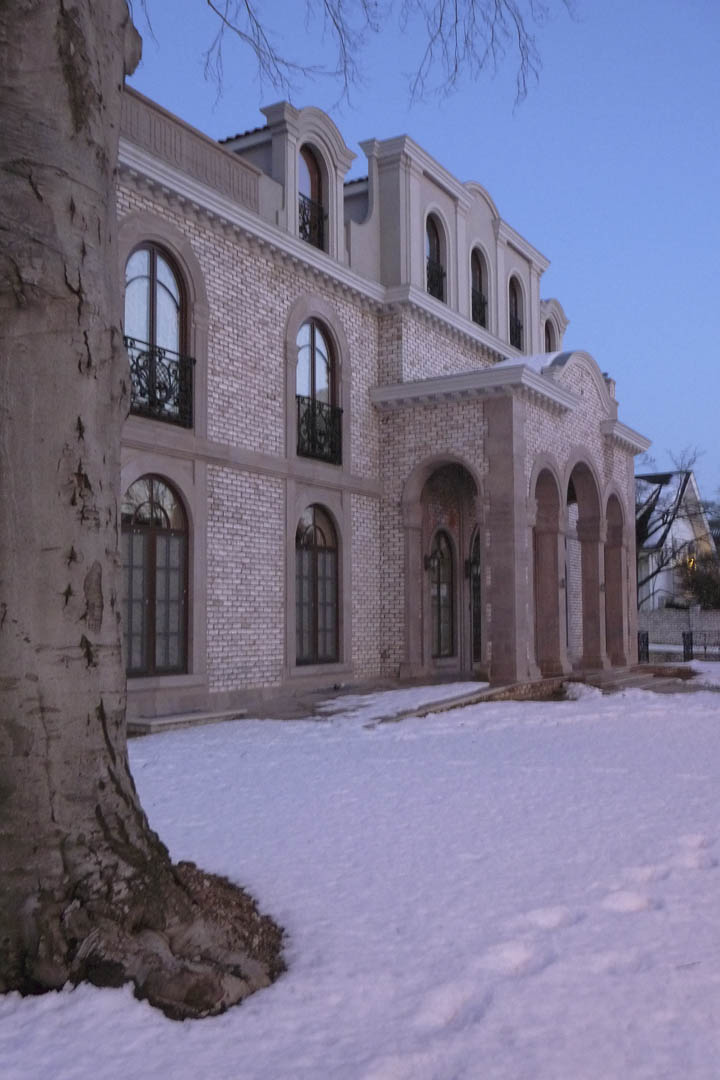
Dave and I wander off the main drag in search of some spectacular houses we’ve read about in the Times. And there they are, just beyond the blocks of nondescript bland brick apartment buildings that could be anywhere in the city and are a blight on the landscape—why the hell can’t even low-rent housing be built with an eye to aesthetics? Commanding tiny lots in a neighborhood of sedate Colonials and bungalows that suggest any prosperous mid-Atlantic suburb, these sand-colored brick anomalies draw on a grab bag of architectural traditions.


They have Ionic columns and Palladian windows, marble balustrades and French mansard roofs, and the strangest shiny stainless steel gates that belong to no history of ornament I’ve ever seen. We spot an ultra-sleek structure with tall curving windows, suggesting a drug-fueled collaboration between Darth Vader and Robert Gwathmey, and another house that resembles an early Christian basilica with 20th-century brick wings. Most have small paved courtyards holding the neighborhood cars of choice—a late-model Mercedes or Lexus. A light shines from deep within some of these stately residences, but they are eerily empty, either newly built or their owners have fled to warmer climes for the season. We speculate that these are the houses and compounds of wealthy diamond dealers and wonder if Architectural Digest might like to pay a visit. Dave can’t stop snapping photos, but I am getting absurdly hungry. And so we are off in search of Bukharan eats.

IF YOU GO: Take the R or V train to 67th Avenue in Queens. From 42nd Street in Manhattan, the trip takes about 40 minutes. Head toward the residential neighborhood, to your right as you climb the subway steps, to find the McMansions.